Ángel Botello Barros
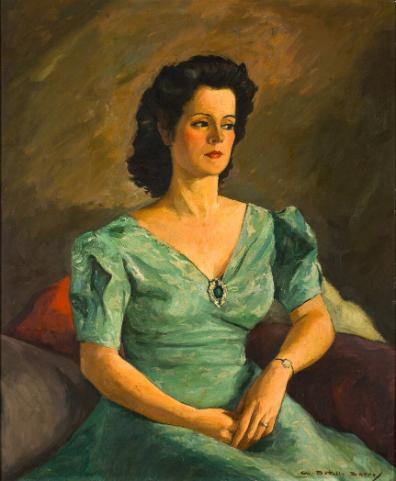
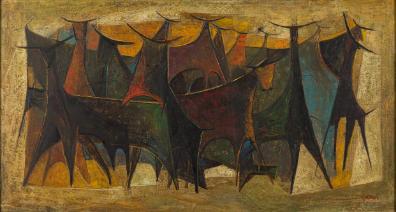
Angel Botello was born in the small town of Villa de Cangas de Morrazo in Galicia, in the northwestern region of Spain. Botello was one of six children (four girls and two boys) of Angel Botello Suárez, a businessman in the fish canning industry. In the 1920's and, after the bankruptcy of the family business, Angel Botello moved to Bordeaux, France with his family and lived there until 1935. While in France, Botello's mother wanted that Angel became a farmer but he wanted to be and architect. In France, architecture is considered a beau art rather than a science and students must take art courses. Botello and his younger brother Manuel studied during four years at the École des Beaux-Arts where they graduated with honors and excelled in drawing, painting and modeling. In 1935, Botello returned to Spain where he applied and was accepted with a scholarship at the School of Art of the San Fernando Academy in Madrid. The few paintings that remain of the young Botello's work in France and Spain reflect and immediate break from his strictly academic training to the impressionist and post-impressionist concepts and techniques that shaped his development. The Spanish Civil War started in 1936, which made him leave his studies and join the Republican Army as a cartographer. He fighted in the Spanish Civil War together with his brother Manuel, who died in the war field. In 1939, the Spanish Civil War ended with a victory of General Francisco Franco and the fascists. After the war ended and, impossibilited to stay in Spain, Botello eventually returned to France to meet with his family who was in a refugee camp. The Botello family decided to leave Europe and move to the Dominican Republic where he was warmly received. The community of Dominican artists and art collectors included him as one of their own and many of the paintings created at this time were presented at the "Latin American Art Exposition" at the Riverside Museum in 1940.During that year, the Botello family traveled to Cuba where they stayed for eight months. Upon their return to Santo Domingo, the Peruvian ambassador there who invited Botello to show them in Port-au-Prince, Haiti in 1944 noted his paintings. After his arriving to Haiti, Botello met Christiane Auguste who became his wife and artistic manager. After his marriage with Christiane, Botello changed his artistic plans to move to Mexico to meet with the greatest Mexican artist Diego Rivera and stayed in Haiti. Botello became increasingly recognized and critically acclaimed. His Haitian landscapes and figure studies are considered some of his best works. In Haiti, Botello developed his artistic career of woodworking and he is considered the father of the Haitian woodcarvings and teached Haitian artists about it. For ten years, the Botello family lived in Haiti until 1953 when they moved to San Juan, Puerto Rico, where they would reside permanently. By this time, he already had gained international recognition in the world of plastic arts. After the Botello family leaved Haiti and arrived to Puerto Rico in 1953, they opened their first art gallery at the Caribe Hilton Hotel. Later, they established a second art gallery at Old San Juan. Botello stated that the light and bright colors of the tropics opened a new world for him and stimulated his creativity. From the 1960's until his death in 1986, his work became more personal as it was enriched by his new favorite theme: his three children. The deep love that he felt for his children and his family is reflected in his later paintings and sculptures. The artist critics called him "The Caribbean Gauguin" for his use of bold colors and depictions of island life. In 1959, Botello traveled to Ravenna, Italy to learn about the mosaic technique and produced some of them but quickly abandoned this technique, convinced that he mastered it. In the 1960's, Botello became interested in printmaking techniques after an art dealer reproduced some of his paintings using this technique. Botello refused to sign these reproductions because he was not consulted and not worked personally on the final production of the prints. For that reason, Botello traveled to Paris, France and learned about the printmaking techniques. He became a master in printmaking techniques and graphic design. Some of his best printmaking works are his linocuts, lithographs and serigraphs. In 1985, Angel Botello was diagnosed with lung cancer caused by heavy tobacco smoking habit. Botello, knowing that his life was in danger, accelerated his artistic production pace and never surrender to his illness. In the last year of his life, at age 73, Botello produced the incredible amount of 22 bronze sculptures in great format and working alone. Botello was characterized because he never used artistic assistants or practitioners. The 33 years that Botello lived in Puerto Rico is considered the most prolific period in his artistic career, in terms of the quality of his paintings and sculptures and the quantity of artwork produced and art mediums used. This artistic period of Botello in Puerto Rico has a strong figurative and surrealism influence and is the period that most recognition produced to the artist. This period is known in Puerto Rico as the "Botellian Style" and is recognized by his caricature figures, especially girls. Angel Botello died in San Juan, Puerto Rico on November 11, 1986 leaving behind an impressive legacy of oil paintings, lithographs, linocuts, serigraphs and bronze sculptures. His former house located at Hato Rey, Puerto Rico now is an art gallery where it displays his paintings, sculptures and artwork of other outstanding Puerto Rican and international artists. Botello works are frequently in auctions alongside Diego Rivera, Rufino Tamayo, Fernando Botero and Frida Kahlo.
Ángel Botello Barros (Cangas de Morrazo, Pontevedra, 1913 - 11 de noviembre de 1986) fue un pintor español. Su infancia transcurrió a ambos márgenes de la ría de Vigo, ya que su padre traslada la pequeña industria familiar de Cangas a Vigo, cuando el futuro artista tenía cinco años. Poco después, reveses de fortuna llevaron a su madre, ya viuda, a trasladarse a Francia. Comienzo a estudiar Agronomía y al fin se decidió por las Bellas Artes, que inició en Burdeos y continuó en Madrid, donde le sorprendió la Guerra civil española. Militó en el bando republicano, por lo que después tuvo que exiliarse, primero en la República Dominicana, después en Haití y finalmente en Puerto Rico, con estadías en Nueva York y México. Se sucedieron sus exposiciones en el Caribe, Norteamérica, Europa. Consolidó su fama de pintor y escultor, mientras en España, y en concreto en su Galicia natal, era prácticamente desconocido. El último año de su vida, enfermo de cáncer, trabajó febrilmente. Falleció en 1986.Las exposiciones póstumas confirmaron su categoría de artista. A Galicia llegó su obra de la mano de Caixavigo, traída por su familia, en 1995.