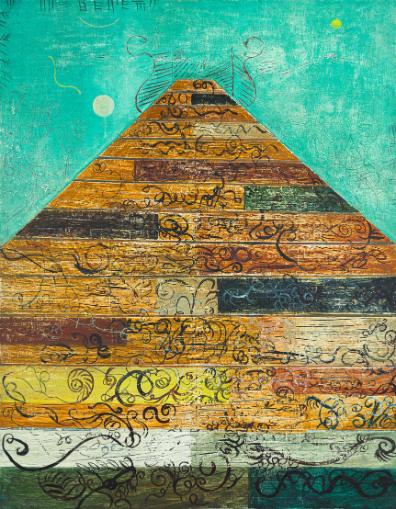
Enrique Tábara
Ecuadorean painter. He studied at the Escuela de Bellas Artes in Guayaquil. In 1955 he received a grant to go to Spain, and he lived in Barcelona until 1964. He first used Expressionism as a reaction against indigenism; Tábara’s work was central to the Latin American movement, which began to abandon social realism in the 1950s. In his early work he painted characters on the margins of society in a hard and grotesque manner. From 1953 he started to experiment with abstraction, and in the 1960s he constructed a language of magical and mythical connotations derived from Pre-Columbian calligraphy. His work from this period is rich in texture, combining elements glued to the canvas, serial calligraphy and telluric forms. In 1969 he began to search for new signs, notably feet and legs (his pata-pata motif), and from 1985 he revitalized his use of colour and added leafy vegetation to the feet and legs in his quest to create morphologies compatible with the mythical culture of American man. Tábara exhibited worldwide to great critical acclaim. Source: http://www.oxfordartonline.com/subscriber/article/grove/art/T082916?q=enrique+tabara&search=quick&pos=1&_start=1#firsthit